Hollywood and the army base, and bipolar realities

Catherine Zeta-Jones

On the one hand, we have Catherine Zeta-Jones checking into an exclusive mental-health facility, diagnosed with bipolar II disorder within five days, and less than a month after that adorning the cover of People magazine.  On the other, we find Jessica Harp, an army wife, posting her suicide note on her blog after multiple attempts to get help both for her husband, a veteran of the war in Afghanistan, and for herself.  A vast gap lies between these two stories.  And yet the distance isn’t as big as it seems.  Depression is a strange unifier.

Good news followed Jessica Harp‘s April 11th blog post, describing how desperate she felt: she is recovering in a South Carolina hospital.  Her blog, {Mis}Adventures of an Army Wife, has been updated, with her mom’s help.  Jessica Harp gives a moving account of what transpired in her life to take her to such a dark place.  The incredible outpouring of support that followed, starting within minutes (200 comments in less than 2 days, with more following), is amazing, even overwhelming, to read.  So much compassion, empathy, and concern—and others sharing stories of their terrible times, from which they emerged.

Both Zeta-Jones and Ms. Harp have done a service, making public such private anguish.  The ordeal may not be over for either of them, but they’ve each found support and treatment.  Depression, post-traumatic stress disorder, and suicide in the military are serious public health issues.  (I touch on this in an earlier post, “What Cynthia Ozick said to me  and a few other things.”  See also, the NYT, “After Combat, Victims of an Inner War.”  Anthony Swofford’s memoir, Jar Head, illuminates the subject too.)  Families of those serving are deeply affected by the circumstances and after-effects faced by soldiers.

Writer and army wife, Alison Buckholtz (author of Standing By: The Making of an American Military Family in a Time of War) has a great essay on the NYT At War blog, “War, Wives and a Near Suicide,” about Jessica Harp and her blog note. (And for an interesting interview with Alison Buckholtz, about being a Jewish military wife, check out “A Conversation with Alison Buckholtz.”)  The internet has helped to create and expand a strong community of military families who, in many cases, are quite isolated, not only from a spouse serving overseas, or a spouse suffering from depression or PTSD after returning, but also from others in similar circumstances.

Back to bipolar disorder….  (To clarify, there is no suggestion that Jessica Harp suffers from bipolar disorder; indications are that she is dealing with unipolar depression.)  Kay Redfield Jamison an eminent professor of psychiatry at Johns Hopkins School of Medicine has written several wonderful books, including memoir, on the subject of mental health, the arts, and bipolar disorder—she herself suffers from the disease—as well as a seminal textbook.  I highly recommend An Unquiet Mind: A Memoir of Moods and Madness, Touched with Fire: Manic-Depressive Illness and the Artistic Temperament, and Night Falls Fast: Understanding Suicide, not just for their interesting, in depth portrayals of bipolar disorder, but for their insights into depression, mental illness, creativity, and mental wellness.  I belatedly came across Jamison’s most recent book, Nothing Was the Same, a memoir about the death of her husband, Richard Wyatt, a scientist and doctor, when I was thinking about my last blog post on grief.  I looked at the first page and then kept reading.  (It’s now in “pause” mode, since, as I mentioned previously, I’m already well into Jill Bialosky’s memoir, History of a Suicide, a deep and involving book, but I look forward to returning to Jamison too.  She is compelling, forthright and highly readable.  I wish I could request a reading-sabbatical, but I think the boys, as well as a few other areas of commitment, might not go for this …so, for now, I eke my way along.)

April has also brought the release of Alexandra Styron’s memoir, Reading My Father, about her father William Styron, esteemed novelist, whose own brief memoir on depression, Darkness Visible, is among the best books yet written on the subject.  He conveys, like few others (and before many others), the intense, inner turmoil and pain of depression (what suicidologist, Edwin Schneidman aptly terms psychache)—such a private and inward experience—in compelling and wrenching prose.  While I have not read the book in years now, the sense of it sticks with me in the way only the best literature can, particularly when read at a personally receptive moment.

William Styron, is one of a collection of writers who helped me step into the torment of my father’s mind, those circling, congested, wrenching passageways of sticky doubt and hurt and struggle.  Styron returned from this suicidal hell, and had the skill and tenacity to convey it such that others might begin to comprehend.  Now his daughter, in Reading My Father, is taking up the subject, rendering how it was to live so close to this whorling epicenter.  I had the pleasure of hearing her speak with lovely candor at the Manhattan JCC the other night, in conversation with writer and producer, Abigail Pogrebin, a long-time friend of Styron’s (and author of One and the Same: My Life as an Identical Twin and What I’ve Learned About Everyone’s Struggle to Be Singular).  Alexandra Styron remarked that her father realized after he had come to suffer severely from depression (following publication of Sophie’s Choice) that “there was suicide in every one of his books,” a revelation that seemed to surprise him.  How interestingly the subconscious mind works; and what remarkable things we learn from the artistic process.  Sometimes what we make up is as illuminative as what has happened and can hold unanticipated truths.

Why do I persist on these melancholy topics, suicide, depression, mental illness, mental anguish?  I suppose, like many compelled to pull at, revisit and revisit a subject, because the extent of its reach still alludes me, because there is much left to comprehend.  I continue to see things in different ways; whether directly related to the subjects of mental health and mental illness, or tangentially, like the dear sweetness of my sleeping five-year-old.  Memory is not static; it is constantly engaging with present moments.

Coming soon. . .the beginning of a brief “serialization” of a lengthy memoir piece I previously published in the literary journal Center.  (It’s almost moving day for me and my family, thus an opportune moment for re-presenting existing material, unavailable on the web!)  ~

~  Stop by karakrauze.tumblr.com for odds and ends on the mini-blog….  ~

Jennifer Egan won the Pulitzer Prize last week for her wonderful novel, A Visit From the Goon Squad.  Hooray!  Her intoxicating first novel, Invisible Circus, takes on the subject of suicide, and must have been one of the first narratives with a central suicide storyline that I read after my father’s death.  Like Styron’s Darkness Visible and Sophie’s Choice, a sensory memory of the book has stuck with me.  It’s been great to see Egan getting such accolades for her most recent work!  ~

Andrew Solomon, another seminal writer on depression (author of The Noonday Demon: An Atlas of Depression which was preceded by a fantastic essay in the New Yorker, “Anatomy of Melancholy“) passed through my sight-line this week when I happened across a piece he published in Newsweek in January, “Meet My Real Modern Family“—touching, illuminating, and beautifully written.  ~

Posted in Memory, Suicide, War, Writing & Reading | Tagged , , , , , , , , , , , , , , , | Leave a comment

What we want to say—when someone else is grieving

Grief and loss are difficult topics to broach.  Death makes us uncomfortable, often renders our words inadequate.  In recent months, several people in my life have been dealing with the death of an intimate (none by suicide), a child, a sister, a grandmother.  In each case, I have struggled to find words to capture the compassion, solidarity, pain, and understanding I wanted to hold out, the load-lightener I wanted to be able to offer.

Grief, like depression, is easily a lonely place to arrive.  I have found—still find—that reading the comforting words of others helps—and equally important is others’ candor.  Grief is messy, awkward, unruly, often complicated by guilt, and even anger.

A month or two after my father died, I saw a “grief counselor” weekly for about six weeks.  I think, in hindsight, I must have resented Dr. S and his stoic calm; as though he were inured to shock, as though his presence in my life were somehow his fault.  In any case, I didn’t particularly take to him.  But what I most remember from our half-dozen hours of conversation—monologue or dialogue—was Dr. S’s assertion that I was angry.  He was wrong.  I was numb, confused, overly sympathetic and understanding even.  But I was not (then) angry.  And yet he was right.  I needed to be angry—why had life done this to me? why had my father?—and perhaps I already was.  In naming my feelings, he legitimized them.  Much as I resented his presumption at the time, he had offered me a branch to hold onto, one I later needed.

Not long ago the New York Times published an “email conversation” (“Why We Write about Grief”; 2/27/11) between Meghan O’Rourke, author of the newly released memoir, The Long Goodbye, and Joyce Carol Oates.  The exchange highlights the inadequacy and awkwardness we so easily feel when faced with someone else’s grief.  O’Rourke lost her mother in December 2008.  Oates’ memoir A Widow’s Story recounts her grief after losing her husband earlier that same year.  At times, although each writer is sharing an experience of grieving, notably for quite different relationships and at distinct stages of life—O’Rourke was thirty-two when her mother died, while Oates was sixty-nine when Raymond Smith, her husband died—there is a palpable disconnect.  Their experiences overlap, but remain unique.  This dance of perspectives is illuminative, as is what is absent from the piece altogether.  More on this later.

Literature has long offered solace to the bereft.  Despite the buzz from time to time that people only want happy stories, that this is what sells, books with more somber themes continue to attract readers.  Sometimes we want escape—sometimes an escape into someone else’s pain or struggle—and sometimes we want to find difficult experiences that resonate with our own.  Author, Randy Susan Meyers recently wrote about this at the Huffington Post (“The Solace of Dark Novels and Memoirs“) and the compulsion to wonder “what if,” taking a bad circumstance and imagining how it might have been if things had been even worse.  Her novel, The Murderer’s Daughters, deals with the somber subject of two girls whose mother is murdered by their father.  A view into someone else’s hardship offers the opportunity for catharsis, and insight into our own troubles.  O’Rourke mentions re-reading Hamlet “over and over” after her mother died:

“His father had just died and no one wanted him to talk about it.  No wonder he felt the world was ‘weary, stale, flat, and unprofitable’!”

When my father died, I had to learn how to talk about death and how to talk about suicide (a whole other trail to pursue at some other time).  I found too few candid accounts of grief—really a one-word stand-in for a diverse array of emotions—particularly grief after a suicide, one of the reasons I felt compelled to embark on my own.  Kind and comforting words are necessary for healing, for feeling less alone.  But honest accounts of the messy realities of loss are invaluable.  We don’t always want to be comforted.  We want to journey with others, to see how they too felt lost, angry, guilty, confused, listless; how they remembered the dead, sometimes as though they were still there, sometimes forgetting, unable to comprehend, that they never would be; how they made a mess of things, couldn’t get out of bed, or how they pretended over and over that everything was normal when nothing was and, they felt, nothing ever would be again.  How they felt all of these things, or some of these things, how once they felt one thing, with overwhelming certainty, then suddenly they were feeling something else.  And then how things began to change, how things grew easier; still they were different than before, but somehow they could still go on, still be whole, almost whole, whole again, despite that loss carved from their lives.  (I also touch on this in the recent post, “Remembering—who we are.”)  This process of grieving is not linear; we move forward, move back, circle around, move forward again, dance back, and so we go, this way and that.

More books have joined the slender shelf of bereavement memoirs, particularly suicide bereavement, since my father died sixteen years ago.  (One of these days, I’ll put up a list here.)  Recent books by suicide survivors include Joan Wickersham’s The Suicide Index: Putting My Father’s Death in Order (see the comments section of “Ulnar-nerved mama—when you want to be a superhero”), Nancy Rappaport’s In Her Wake: A Child Psychiatrist Explores the Mystery of Her Mother’s Suicide (which I mentioned in “Ulnar-nerved mama,” after which Nancy Rappaport posted a thoughtful comment), Linda Gray Sexton’s Half in Love: Surviving the Legacy of Suicide, and in February, poet, novelist, and editor Jill Bialosky published History of a Suicide: My Sister’s Unfinished Life, her account of her sister’s suicide at age eighteen, which I’m reading now.  These are all memoirs, a genre that holds a particularly important role in literature about suicide, perhaps even loss in general.  Sometimes we need to know that a story is true.  (I won’t get going here on the importance of honesty in memoir, emotional truth and historical accuracy, slippery though memory can be.)

Often these true stories have elements of the unreal, details that seem impossible, more than fiction might even get away with.  We need to know that these strange or extreme realities are the case in others’ lives, not just our own.  That said, I have also been a big fan of David Vann’s collection of stories, Legend of a Suicide, which arose from his father’s suicide (and his memoir, A Mile Down, though it treats suicide only obliquely, informative in its own way).  (Vann’s new novel, Caribou Island, which I have not yet gotten to, has also been highly praised.)   Legend of a Suicide was selected by Lorrie Moore for the New Yorker’s book club last spring; a pick which felt a bit like a personal triumph, involving as it did public exposure for an often stigmatized or taboo topic, a private crusade for years.

Circling back….  The Times piece“Why We Write About Grief” is fronted by a list of recent memoirs about grieving, including Joan Didion’s fantastic book The Year of Magical Thinking, and yet none of the six books mentioned (including the authors’ own) takes on the subject of grieving after a suicide, despite this spate of new accounts, at least one (Jill Bialosky’s History of a Suicide) even published the same month as the conversation and accompanying list.  This omission is illuminative, whether an accident (entirely plausible) or deliberate.  If we wish to keep our distance from grief, certainly we feel this in spades when it comes to suicide.

A year earlier, Meghan O’Rourke published an engaging compendium of perspectives on grief in The New Yorker, “Good Grief: Is there a better way to be bereaved?,” which I’ve only just read as I wrap things up here.  The essay is particularly attentive to Elizabeth Kübler-Ross and her theories on the stages of grief and of dying: denial, anger, bargaining, depression, and acceptance.  Later in life, Kübler-Ross came to lament that these “stages” had been taken too programmatically.  Grief is much messier than any straight-forward list or trajectory.  I found a number of interesting reminders and insights in O’Rourke’s essay; and yet, I regret to say that much of this was dwarfed for me by the conclusion, a moving Emily Dickinson poem, “I Measure Every Grief I Meet,” a poem which certainly deserves a place in a discussion of the painful emotions of grief, but one which in the context of suicide—a context which affects all of us, whether we acknowledge it, or have been forced to acknowledge it, or not—is careless and distressing.  As O’Rourke points out, “the speaker’s curiosity about other people’s grief is a way of conveying how heavy her own is”. . .

I wonder if It weighs like Mine—
Or has an Easier size.

I wonder if They bore it long—
Or did it just begin—
I could not tell the Date of Mine—
It feels so old a pain—

I wonder if it hurts to live—
And if They have to try—
And whether—could They choose between—
It would not be—to die.

I am no stranger to the feeling that death was easier for my father than the grief he left in death’s wake—and I do not say this lightly.  Although his life was painful at the time of his suicide, from his suicide notes I can see the agony of dying; this without even knowing what torment went through his mind and body after he put down his pen, once he picked up his gun.  In ending his agony, my father bequeathed it to others.  So, on some level I can agree with Dickinson, it was easier for my father to die than for me to deal with the mess he left afterwards.  But, taken too far, this homage to grief comes too close to recommending suicide as a way out of grief’s temporary pain.  Not temporary as in here for a little while and then forever gone, but temporary because life goes on, the joys of life return.  So, yes, let’s say how hard grieving is—but let’s remember why we are so much more fortunate to be alive.  The essay, dealing as it does so adeptly with the very real difficulties and fluctuations of grief, has a responsibility to offer balance.  Not to make things falsely bright or cheerful, but to remind that grief, while something we continue to experience throughout life, is not a permanent condition.

Perhaps I have been too harsh here.  It is all too easy to romanticize suicide, something my father did exceedingly well.  (German literature, his field of expertise, offers some of the best examples.)  I’m sure I must be guilty of it myself at times.  But I believe wholeheartedly in the struggle against this temptation.  Suicide—death—they are not romantic, for the dying or those left with the aftermath.  Hard as grief is, nothingness is worse.  And they are not something we choose between; grief is rather unfairly doled out.

We need narratives about grief, about suicide and suicide survivors, honest true accounts, and honest imagined versions too.  Certainly, they are not always easy to read, but this makes them no less necessary.  (At its best, Dickinson’s poem, while dangerously suggestive as a conclusion to an examination of grief’s scope, is a reminder of this.)  Stories of grief, of suicide, are painful, filled with what-ifs, with dramatic and hurt-filled choices, with unchangeable events, with survivors left with anguish, with a messy aftermath.  Grief is like this.  (I still think back on a memoir I read years ago about a young man whose wife, barely thirty, suffered from terminal cancer.  I recall It Takes a Worried Man, by Brendan Halpin, as a wonderful and honest book about illness, loss, and living.)  How necessary it is to read of others’ experiences, whether better or worse than our own.  We learn about ourselves, and we learn about the complicated web of humanity, our minds and actions—what makes us alike and what makes us different.

Meghan O’Rourke‘s memoir, The Long Goodbye, about her mother’s death was reviewed in this weekend’s NYT Book Review.  A moving excerpt is also included.  ~

~  For an interesting clinical analysis of the differences (and similarities) between grief and depression, take a look at “Grief and bereavement: what psychiatrists need to know,” by Sidney Zisook and Katherine Shear in World Psychiatry.  ~

Posted in Memory, Suicide, Uncategorized, Writing & Reading | Tagged , , , , , , , , , , , , , , | 2 Comments

David Foster Wallace’s widow, Karen Green, speaks about his suicide

A full post will be coming soon….  In the meantime, don’t miss this wonderful interview with David Foster Wallace’s widow, artist Karen Green, in The Observer, a major Sunday paper in Britain (“Karen Green: ‘David Foster Wallace’s suicide turned him into a “celebrity writer dude”, which would have made him wince‘”).  Tim Adams, the interviewer, does an adept job of avoiding romanticizing or sensationalizing suicide, and Karen Green speaks with painful candor about not only Wallace’s depression but also the legacy of suicide.

“Green has been much concerned with language, and the point where it gives up its ghosts of meaning. ‘When the person you love kills himself time stops,’ she says at one point. ‘It just stops at that moment. Life becomes another code, a language that you don’t understand.’ ”

“It’s tempting to see all this layering [in Green’s art] as a painstaking effort on Green’s part to understand her husband’s death, but it’s clear she sees it more as an expression of the absence of meaning that has resulted from it, the wild and whirling words of grief. She resists the idea that suicide is in any sense a meaningful act, still less one understandable in terms of art – the myth of the romantic depressive – as many of the multitude of commentators on Wallace’s death, grouping him with Kurt Cobain, have sometimes wanted to see it.”

Adams excellently crafts his profile, presenting the depth of Wallace’s struggles with depression and the havoc and deep pain his suicide has left for his wife and others.

Though the piece is long, it is well worth reading to the end.  My upcoming post on grief (delayed in part because of thoughts about endings in respect to the subject of suicide) should be up in the next day or two.

~  Stop by the mini-blog at karakrauze.tumblr.com too….  ~

Posted in Suicide, Writing & Reading | Tagged , , , , , , , | Leave a comment

“See that my brain”—a suicide note’s mixed message

Dave Duerson, former NFL player for the Chicago Bears and two-time Super Bowl champion, shot himself in the chest in February.  I don’t usually make it to the sports page, so the news reached my radar when his death hit the front page of the New York Times (“A Suicide, a Last Request, a Family’s Questions“) on February 23rd, almost a week afterwards.  This was front page news not because Duerson had died by suicide, but because he linked his suicide with possible brain disease.  As the Times reported:

“The pertinent question is whether Duerson had chronic traumatic encephalopathy, the degenerative brain disease recently found posthumously in about 20 retired players, a disease that has been linked to depression, cognitive impairment and occasionally suicide.”

In an earlier article, “N.F.L. Players Shaken by Duerson’s Suicide Message”, the Times noted that several others of these twenty players with chronic traumatic encephalopathy had also killed themselves.

As we now know, Duerson shot himself in the chest (rather than the head) with the intention of offering his brain to Boston University’s Center for the Study of Traumatic Encephalopathy.  One of his final messages, preceded by a similar text to his ex-wife, was a scrawled note:

“Please,

See that my brain is given to the NFL’s Brain Bank.”

Duerson wanted his brain to help with research into the physical brutality of football, a mentally brutal game too, it is becoming increasingly clear.

While Duerson’s act has the tint of generosity, it is worth noting the pain and suffering caused to Duerson’s family, friends, and fans by his suicide.  Let’s not forget that, despite Duerson’s evident allegiance to fellow football players, he is also part of another, larger group: those who suffer from depression and have reached a point where ending life felt more manageable than going on.  A sad, tragic, condition to find oneself in.

Approximately 33,000 people, in the United States alone, die by suicide each year.  About 1 million globally.  For each person who kills him or herself, an additional 12 to 25 make an attempt.  That’s between 400,000 and 800,000  “unsuccessful suicides” each year in the United States— in the order of half a million cries for help, in just one country.  Each event impacts numerous family members and friends.  Suicide occurs amongst the young, the old, the middle-aged; it affects both men and women.  While statistics sometimes illuminate racial and cultural variations (higher or lower rates), no group is immune.  We are not familiar with suicide, not intimate with its aftermath, until suddenly we find that we are. What a confusing place this is to arrive.

Despite all of the taboos that have been broken in the last fifty years—all of the boundaries pushed, all of the changes, a greater openness, greater awareness of difference—the word, suicide, still troubles us.  As it should.  Suicide is deeply troubling.  And yet it should not be a stigma, a shameful secret or embarrassment, carried around by surviving family and friends.

A recent conference, held in Florida, and set up by an agency of the Department of Health and Human Services, addressed the subject of appropriate media practices for reporting on suicides.  It is interesting to hear of and think about the reasons for journalistic protocols on suicide coverage.  Chris Cobler, a reporter who attended on behalf of the Associated Press Managing Editors board of directors, took up the subject in a blog post, “What are best practices for reporting on suicide?” for a Texas newspaper, The Victoria Advocate:

“Suicide is one of the most difficult subjects any journalist encounters. Coverage may lead to feelings of anger, pain and denial directed by survivors toward the media organization.”

Two days later, in a new posting, Cobler report on the meeting (“Why are mental health issues so taboo?”) , citing Dan Romer of the Annenberg Public Policy Center sharing research that many journalists don’t want to cover suicide, and do so according to several criteria: if…

  • It occurs in a public place or involves a public person
  • It involves a murder-suicide
  • It occurs in a prison or state institution

Or

  • It is a suicide in the military

Reporters fear contagion, the risk of others watching the coverage and replicating the act.  Considering the responsibilities of journalists to report, and to report ethically, made me think anew about the conundrum of suicideneeding to speak of it, while of course not wanting in any way to encourage it, to present it as an option for escaping depression and deep psychic pain.

In the years since my father’s death, each time I read of someone’s suicide—whether a public figure or a complete stranger, I am deeply saddened; my father, his life and death, is inter-tangled with whoever I am reading about.  But I need these accounts.  I need to be reminded—of at least two things.  One, that I am not alone in this peculiar reality, that, in fact, suicide is a real public health problem, not merely a freak occurrence, but an issue that demands attention, for survivors, and, of course, for those who suffer, from depression, from mental illness, enough to decide to end their own lives.  Two, I, and others, need to be reminded of those who might need help around us, whether close to us, or not.  I don’t kid myself that the problem of depression or mental health in general can be eradicated.  On some level, we wouldn’t even want that.  A variety of moods and of experiences, unhappiness as well as happiness, is part of, and essential to, the human condition.  But there are questions of degree.

It seems that Dave Duerson wanted to find out if football had contributed to his declining health, his mental state, his loss of memory.  Perhaps he wondered why his finances were in trouble, his house in foreclosure, his business bankrupt, why his marriage had gone wrong.  His death suggests that he felt it was too late for him, but he wanted to find out what might be done for other players, past, current, and future.   Of course, this would be valuable information, and perhaps Duerson’s brain will add to the knowledge amassed by such study.  But, despite his stated altruistic intent—to assist others who might suffer at the hands of football—Duerson also presents classic risk factors for suicide, a devastation that can be avoided, even while it was not in this case.  (See my first post on Mark Madoff, “How Madoff the younger became my kin,” for my take on the complicated relationship between what is done and cannot be changed—and what we can learn and do differently in present time.)

When I think of Dave Duerson now, I think of a man who didn’t want others to suffer as he was—a man trying to understand if the game he loved might have caused this suffering—and a man who, like others, needed help in overcoming the conditions in his life—shaped by his body and by his brain.  He was a man who needed a hand.  He had a brain that deserved better—broader choices and greater care, while he lived.

In the news… Former NFL lineman, Shane Dronett, who retired from the Atlanta Falcons in 2006 and shot himself three years later, was recently confirmed by Boston University School of Medicine’s Center for the Study of Traumatic Encephalopathy to have suffered from CTE.  His wife, Chris Dronett, describes his grueling decline, and suicide, in an interview on CNN.com,”Ex-Falcons lineman had brain disease linked to concussions“.  ~

~  Stop by karakrauze.tumblr.com for tidbits between weekly posts here.  ~

~  Check out last week’s post (“Remembering—who we are“) for further investigation into how memory and narrative affect (and help) depression and grief.  ~

Posted in Memory, Suicide, Writing & Reading | Tagged , , , , , , , , , , , , | 4 Comments

Remembering—who we are

I’ve been dipping into a fascinating book, In Search of Memory, by Eric R. Kandel, winner of the 2000 Nobel Prize.  A particular passage has been sticking in my head in which Kandel addresses “the role of memory and dysfunction in other forms of mental illness, and even in the biology of mental wellness.”  Consider how much we count on not just our thinking faculties, but our memories!  Our past, the past of others—experiences and what we learned from them—enable us to process what is happening here in the present, right now.

How can we make sense of something as simple as ordering a coffee, if we can’t remember having done so before?  How much easier it is to care for a newborn when it’s your second than your first.  All those memories of not only what you did before, but how you coped.  Or, the flip side, if you’ve been through a terrible experience, a trauma, then some completely different experience can bring it back with a smell—flowers at a party, and suddenly you’re remembering the scent of carnations at your cousin’s funeral.

We need this, the push of memory, it makes us who we are.  Sometimes it seems to define us, but we use it to define ourselves: what we accept and what we resist, in our pasts, in our families, and in ourselves.  Kandel points out “that depression often compromises memory severely.”  Experientially, as well as biologically, this makes sense.  A foggy, under-energized brain has trouble pulling up what has happened, what needs to be done.  Mental inertia can paralyze thought and action.  We need the ability to recall the pastindividually and culturallyin order to move forward.

While I was working on the book about my father (Exit Wound: Suicide is Not a Love Story), I often returned to a quotation from Freud, in his essay “Mourning and Melancholia,” as a sort of ballast, a reminder or held-out hand:

“[W]e do not even know by what economic measures the work of mourning is carried through; possibly, however, a conjecture may help us here.  Reality passes its verdict—that the object no longer exists—upon each single one of the memories and hopes through which the libido was attached to the lost object, and the ego, confronted as it were with the decision whether it will share this fate, is persuaded by the sum of its narcissistic satisfactions in being alive to sever its attachment to the non-existent object.”

Sigmund Freud

Rereading this passage now, it seems a bit harsh, but the gist of it is true. Not that we stop being attached or cease to care for the person we’ve lost, but that we have to pass through the period of recurring pain; we have to return to a life we are living, not just a life we are living with death (the lost loved one) by our side.  After a loss, we keep encountering things that remind us of the deceased, concrete things in our daily lives (a room, a book, an upcoming event, a smell or even a feeling), and, too, our minds come upon eruptions from the past (that picnic two years ago, a wedding, learning to play backgammon, a fight).  The future chimes in too—he or she will not be here for….  We need to experience these reminders, these pain-filled memories, but then we need to begin to see things through a lens that is not only shaped by who is missing.

I will be tackling the subject of grief (so inter-tangled with memory), in one of my upcoming posts.  But memory not only pertains to what we’ve lost, it is a frame for what we have experienced—and who we are.

We pull our memories into narratives—into stories—in order to find coherence.  We need the past, on some level, to make sense.  We need to glue together the details and events; they need to stick together, and form something comprehensible.  My almost-three-year-olds’ activity with the scissors comes to mind.  He loves to cut—and cut and cut.  If I turn away for just a few minutes, the table and floor are soon scattered with multi-shaped, sometimes jagged, small and large, fragments of paper—white, red, crayoned or markered or plain.  It’s a mess, and until I can bring myself to pull out the broom or stoop down to scoop them together (and those pieces always catch here and there, scatter further and resist the pull of my fingers), they seem overwhelming.  Sometimes I ignore them for hours.

Okay, so my housekeeping is less than perfect.  But the point here is two-fold.  It takes energy and effort to make order from chaos—whether the mess of memory and history, or the mess of a preschooler—and I feel so much better once it’s been done.  Honestly, not just the dining room, but the whole apartment, even my outlook on other things that need to be accomplished, looks better.  I’m not really trying to make an argument for spending more time cleaning up.  (Though I suppose I’m reminding myself it might prove useful in more ways than just the possession of a cleaner apartment.)  But that our minds are similarly affected by fragments of memory—thoughts and experiences that have not been organized and integrated into our sense of self impede us, slow us down.

I know I had this experience in working on my memoir about my father.  The research, thinking, reading, and writing were sometimes traumatic—I was at times reliving my father’s death, the long wind up (decades of depression), and then, too, the blood-soaked aftermath.  But, through this process, I gained a way of speaking about his death (about suicide), not just to others, but to myself.  I would be lying if I pretended that this was a neatly confined period—research, write, remember, then it’s all done—though I think for a while I thought of  it this way.  I probably needed to.  But then more experiences come along—marriage, having children of my own—and those need to be joined to the narrative too, not always a seamless process.

For me, the process of remembering (thinking things through and integrating them into who we are) is as valuable as the result, both of which are somewhat elusive, like memory itself.  But I feel better when I’m doing it—thinking about the past, thinking about the present, remembering.  Memory isn’t just about what happened—in the past—what is done and concluded.  Memory is the essence of who we are—in the present and the future.  As Kandel writes,

“It is, of course, memory that weaves one’s life into a coherent whole.”

~  As I was wrapping up this post, I came upon an interview with Austin Ratner,  in The Cleveland Plain Dealer, when his excellent debut novel, The Jump Artist, came out in 2009.  The Jump Artist just won the 2011 Sami Rohr Prize for Jewish Literature.  In the Plain Dealer interview and in another interview in Harper’s, Ratner talks about the role of memory, trauma, and loss in engaging ways.    Check out the interviews (links above) and then the book…here!  ~

~  More on our need for cohesive stories next week (and the next), when I hope to finally get to the topic of Dave Duerson (the former NFL player who killed himself last month) and the subject of grief.  ~

~  New fragments will also be popping up at karakrauze.tumblr.com ~

Posted in Memoir, Memory, Suicide, Writing & Reading | Tagged , , , , , , , , , , | 2 Comments

Ulnar-nerved Mama—when you want to be a superhero

Ulnar nerve transposed...

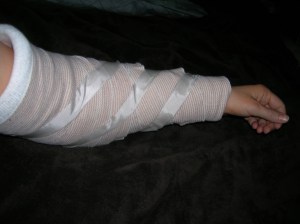
Here I am at the computer, wondering whether the internet, particularly its subset, or offspring, known as the blog, should be classified as heavy machinery, which I’ve been warned to refrain from using.  The doctor seems to think I can type with my left arm in an all-but-full-length bandage and my elbow in a splint.  Turns out he is right.  But my brain on percocet is not the same as my brain without.  No surprise there.

If you’ve been reading regularly, you may recall my post on Cynthia Ozick a few weeks ago (“What Cynthia Ozick said to me—and a few other things”) when I mentioned spending too much time at The Hospital for Joint Diseases for a normally unnoted part of our bodies, the ulnar nerve, a worker within the elbow’s network that affects mobility, strength, and sensation in the two smallest fingers, pinky and ring, and eventually parts of the whole hand.  If the ulnar nerve is pinched, the pinky finger and part of the ring finger start to tingle, like they’ve fallen asleep, then begin to grow numb, then, if you’re in that “eventually” category (turns out I was), the rest of the hand weakens and begins to lose sensation too.  This was all happening, pretty quietly, I’d say, on my left side, for quite some time, until those fingers went numb and tingly and stayed that way, oddly synchronized with the period when I was dealing with school decisions for my older child and joining Facebook.  Funny how the mind and body communicate in subterranean fashion without our conscious brain’s participation.

So this past Monday I checked in to the HJD to deal with an entrapment and transpositionDoctor—or spy—lingo for procedures to un-trap the ulnar nerve and move it.  (Like many, it had never occurred to me that a nerve could be moved.  Frankly, I hadn’t given any thought to one being trapped either.)  I joked with my boys ahead of time that they could call me “one-armed Mama.” The older, a vocabulary sponge, decided on “ulnar-nerved Mama” instead.  I can’t say I want to be defined by one particular, rather faulty, nerve in my elbow, and yet there is the faintest hint of super-power potential in the claiming of ailment as identity.  Sometimes our weaknesses, or our burdens, are our strength, even when—or because—they need to be surmounted.  Even when—and because—they feel more like burdens than strengths.  They drag us down, but then we’re forced to make our way back up.

I don’t know if it’s because of how my father died that I find myself compelled to think of trials as opportunities; or perhaps it has as much to do with watching him struggle with depression, though that struggle didn’t have a name during most of my childhood.  In any case, ulnar-nerved mama is trying to enjoy a little bit of foggy brain: move more slowly, focus on the basics, rest, and (I had imagined) read, though this turns out to be less feasible than I’d hoped, and ponder, in a winding and murky sort of way.  I must say having a lame arm and being on pain medication reminds me a bit of the sleepless, time-warped fog of having a new baby.  Mustn’t roll over on the baby (ditto for the arm), wake up every few hours to feed the baby (take a pill) or wonder if the baby is still breathing (check if a child is about to climb into bed, thus crushing the arm).  But at least this fog will end much sooner, and my arm won’t need a bigger apartment.

~ Drop by karakrauze.tumblr.com for other meandering thoughts and tidbits this week and next. ~

supporters and taskmasters (and superheroes)

Posted in Memory, Motherhood, Suicide, Writing & Reading | Tagged , , , , , , , , | Leave a comment

The legacy of suicide – Mark Madoff redux

I usually save this space for original essays (using tumblrkarakrauze.tumblr.com—for interesting articles, quotes, and tidbits).  But The New York Post, admittedly not my usual go-to paper, recently published a story about Stephanie Madoff that speaks to the legacy of suicide—the grief, anger, hurt, pain, and turmoil that follow the act.  The article, by Annie Karni, serves as a welcome follow-up to my post in February about Mark Madoff, “How Madoff the younger became my kin“.

Here’s the link to the story from The Post:

Madoff’s Ultimate Victim

Bernie Madoff swindled investors out of millions, but after the sudden suicide of his elder son, Mark, it’s his daughter-in-law who suffers the most tragic fate of all.

(I also recommend New York Magazine‘s in depth interview with Bernie Madoff, “The Madoff Tapes,” by Steve Fishman.  It’s a fascinating look at a complicated man—and speaks to the urge to remember, revise, create and control our own histories, while also examining again the painful circumstances that preceded Mark Madoff’s suicide and the pain his suicide left behind.  Here, we are given a glimpse of Bernie Madoff’s humanity, and reminded of Mark’s mother, Ruth Madoff.)

While The Post is right to suggest that Stephanie Madoff, Mark’s widow, is among Bernie Madoff’s biggest victims (along with Ruth Madoff and her younger son, Andrew), it is Mark’s children who will carry this particular burden in especially complicated ways for the rest of their lives.  Mark has two older children, from a previous marriage, and a four-year-old daughter and two-year-old son from his marriage to Stephanie.  Nancy Rappaport‘s wonderful memoir, In Her Wake: A Child Psychiatrist Explores the Mystery of Her Mother’s Suicide, speaks poignantly of the particular grief, self-doubt, and pain of losing a parent to suicide so young.  I am reminded here of Sylvia Plath and Ted Hughes, and their son Nicholas Hughes’ suicide two years ago (see “A gulf to fall into: suicide in the house“).

I was lucky, if you can call it luck.  I had just turned twenty-three when I lost my father.  I have memories, many of them difficult or painful, but I knew my father.  Certainly, after his death, I had to question what I knew, much had shifted and could only be viewed, at least for a while, through the lens of his death.  And I learned new things, details and stories, of guns, of violent behavior, of hurts he had carried within, some for decades.  But I had known him, had experienced the strength of his ire and the bittersweet intensity of his love.

My understanding of depression has grown more nuanced since my father’s death, and my experiences as a parent shape and re-shape how I look at my father’s parenting—the difficulties he faced and his shortcomings—and what he strove for.  Even his love, though too often expressed through distrust or anger or stubbornness, has grown more complex with hindsight.  Having become a parent myself, I better understand how overwhelming and intense the love of a parent for a child is.  (I think here, again, of Ruth’s pain in the aftermath of Mark’s suicide.)  I know my father now, more than a decade and a half after he shot himself, in new ways.  As adults, even without tragedy, our view on our parents shifts, and shifts again.

Through a trick of technology, of sight and chance and insight, I just clicked on a photo of my father I used in that earlier posting about Mark Madoff, unsure where it would take me.  I assumed some dead-end, a url-blockade, the end of the road, that road designed, in part, by me.  (Yes, you can see I am learning the technical details and possibilities of blogging and website formulation as I go.)  But with that click of the mouse, the photo enlarged, expanding beyond my screen.  My father’s eyes commanded the screen—looked out at me—the one eye teasing through his piece of carved onyx, a circle-in-a-square—and he was before me in a way I have not felt in years.  Perhaps ever.  Our relationship was too fraught, filled, even during my childhood years, with mutual recrimination, with sadness and regret.  His struggle with depression, unnamed, but almost omnipresent, had its tentacles wrapped into us both.  He fought to stay afloat—something I only partly understood then—and I struggled to keep my distance.  His pain was consuming, too much so for him, and for me.  It shouldn’t have been.  It needn’t have been, so many avenues—therapy, medication—went untraveled.  And at such a cost.

Here’s that photo again.  Of course, looking into my father’s eyes won’t mean the same things to you as it does for me.  But meeting anyone’s gaze, thinking of that person’s life, of all of the lives it touched, offers the chance to look again at our own—and at the others around us, depressed or not.

Lawrence Frye, 9/11/34 - 7/4/94

Posted in Memory, Motherhood, Suicide | Tagged , , , , , , , , , | 2 Comments

From Russia with love—unexpected gifts and the open horizons of youth

Snowy Days

Last week I met Cynthia Ozick, stood within (almost) spitting distance of Meryl Streep, and received a surprise package from Russia.  First of all, I would never, ever spit at Meryl Streep.  She is amazing.  Since I first saw her decades ago in The French Lieutenant’s Woman or Silkwood or The Deer Hunter—all outstanding performances—I have been in awe.  While The Devil Wears Prada and Mamma Mia may be lighter fare, she remains a goddess not only of screen, but of thinking, doing women everywhere.  The poise!  The intelligence!  My youthful ardor was only reinforced by the wonderful experience of hearing her speak and read at my alma mater’s sesquicentennial celebration in midtown Manhattan, the night after hearing Cynthia Ozick downtown.

I’m afraid this gives a rather deceptive view of my social and cultural life.  This was an unusual luminary-filled week, and by week’s end, I was beyond exhausted.  The kids don’t really care if I’ve been out late living the NY cultural dream.  If anything, they are more inclined to wake early.  They miss mom.  Meryl Streep was one of the few presenters or alumnae the other night who made reference to her role as mother.  Perhaps because her external achievements are amply evident to the public eye, she did so with grace and ease, and it took nothing away from the public person we know her as.  Instead, it gave a peak into her private life.  “Mommy, tell me a story,” she recounted her kids telling her when they were young.  “And make it about me.”  What the kids want, and still what the moms sometimes want too.

Back to the subject of missing.  (And a nod to my little guys for pushing me forward on the path of thinking about the different kinds of missing we do.)  So, I’ve been doing some missing of a different sort.  Cultural longing, you might say.  This unreasonably snow- and ice-filled winter in New York (and elsewhere) has had me remembering being young and in love in Moscow—and learning how to walk like an old woman.

There I went, age twenty, stealthily picking up one boot, setting it down, then picking up the other, bulky coat, fur hat pushed low on my forehead and ears, eyes pointed down.  I don’t remember the precise instructions I received, but I was made to understand not to look people in the eye, perhaps men, but women too I think, for someone might take offense—at the scrutiny, the challenge, the foreign gaze—or the young woman’s look might be misconstrued as sexual advance.  In any case, I yearned to fit in, had been practicing it in various ways, and in different environments, since I was a child.  Not always the most admirable trait, to avoid attention, to want to seem like others, but in foreign circumstances I look upon it a little more forgivingly.  I wanted to learn what it was like to be someone else.  And, yes, I wanted to be someone else.  And I was!  Midwestern girl transplanted to…Moscow!  I was nervous, and I was thrilled.  Thus the downturned eyes, the Moscow ice-walk.  It must be that younger women, of necessity, practiced this cautious, yet sometimes still fast-paced, tread across slippery sidewalks, gaze averted, though I now associate it with those further on in years.  Blend in I did, more often mistaken for a central or eastern European than American.  For the first sentence or two anyway.  I remember buying a bottle of limonaya vodka at an outdoor kiosk, I think spring was trying to push its way through, the days were getting longer, the air warmer, and being asked if I was Bulgarian.

Strange what memories affix themselves into the necklace of our experience.  Sometimes we miss what we’re used to having all the time (a briefly absent family member, even a cup of coffee), a kind of knee-jerk reaction, a habit, a love for what helps and comforts us.  Sometimes we miss more ephemeral things, a feeling or sensation, a sound or experience, whether brief or enduring.  What we remember, the specificities of our own memories, is important not just for the details or facts they convey to someone else, but for the accompanying sensations they bring to ourselves.  We long for what was never had, or for what we no longer have.  This is how I feel about Russia, it is something I had, and something I never had.  My brain turns wistful when I hear the endearing sounds of the language, the mouth more concise, the tongue muscle working while the cheeks and lips pull more tightly around the sounds.  I think I must have associated the sounds, the alien amalgams of new consonants and vowels, with longing even before I knew the language.

I remember a fantastic memoir I read during high school, In My Mother’s House, by Kim Chernin, holed up in my overly pink bedroom.  I can pinpoint the time as my senior year, since we had just moved the summer before, and my new room provided me with a pink carpet, outdoing my pre-existing pink duvet and curtains.  (Feminist child of the seventies and eighties, I had a brief period of girlish, domesticity-laced rebellion.  Cynthia Ozick confesses to a similar pink phase, as a child, in conversation with Robert Birnbaum at themorningnews.org.  Now, like Ozick, I eschew pink in favor of darker hues.)

In her memoir, Kim Chernin was learning about, and remembering, her mother’s Russia, trying better to understand her mother’s American communism and their relationship.  The book was deeply personal, a cultural exploration, and yet probed the politics of the Cold War with feeling and insight.  During those years of nuclear fear, I kept returning to the question of people.  How could the Russians be so different from us?  Why was Russia so vilified?  In middle-America, in my small, rather conservative town in Ohio, this was all the more evident.  People’s views were solid, intractable.  The Soviet Union was the evil empire.  And then only a year later, the Berlin Wall fell.

Obviously, thinking has changed in the two decades since.  Yet Russia still feels so far away.  I have not been back since my semester living and studying there in 1992.  That seemed completely impossible while I was still in college.  Of course, I would return!  The experience, the skills gained, were so important to me (are still, though in different, and less practical ways) that I could not fathom becoming estranged or distanced from them.  I was in love.  With Russia, but also with the sense of possibility that lies before us in our early twenties.  Anything is possible—everything is possible.  Until we learn that life is a series of choices.  One important thing recedes, another takes its place (rent, a place to live, security, adventures in different hues).  Our needs and activities change as we age, and yet the essences of those formative experiences (whether playing in a band or performing on stage; even the mood of a particular story or lesson that captivated us) stay with us.

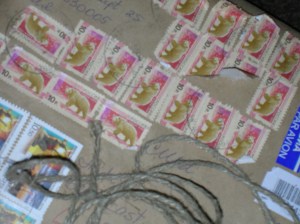
And so it was with added pleasure that I received a package in the mail last week, wrapped in brown paper, tied with brown twine, covered in Russian stamps.  The package was from the daughter of a woman I knew briefly a few years ago.  But, as I slid off the twine and unfolded the paper, it was also from the dear friends in Moscow with whom I had lost touch, from the kind strangers who helped me grow into who I am, and from myself, years ago, calling forth.  Inside were two children’s books—for my children to learn Russian.  A stranger, a young woman studying to be a doctor in Siberia, who I know only from a mother’s praises and fairytale photos of her wedding, knew what I needed before I did.

Will my children learn Russian?  Perhaps not.  There will be those in our family who would justifiably feel they should learn the Polish of their more immediate ancestors and living relatives first.  But who knows?  Their future is open; and I can open the books to peer a little further into my past.  Other gifts of memory, or of unforeseen futures, might yet reveal themselves: my children’s dreams, their stories, or my own.  Memory and imagination are great friends.

Stamped from Russia

Posted in Memory, Motherhood, Poland, Russia, Writing & Reading | Tagged , , , , , , , , | Leave a comment

What Cynthia Ozick said to me—and a few other things

Cynthia Ozick

So, the hours I was supposed to spend yesterday morning revising yesterday’s (that is today’s) blog post, I ended up passing at the Hospital for Joint Diseases.  No, nothing serious.  At least that’s how I prefer to think about loss of sensation and muscular control in the two smallest fingers of my left hand (okay, a portion of the hand itself too).  I can still type, albeit with a few extra errors, so it can’t be that bad.  Probably a pinched nerve in my elbow, the neurophysiologist has informed me, the ulnar nerveRather a nice sounding word, soothing almost.  Ulnar.  I like the roll of that L, the way it quietly takes over the N.  Just as the doctor’s x-ray requisition and prescription for a nighttime arm splint took over my requisite writing time.  He’s going to save his verdict about the knife for later.

But back to the L, the sound of a letter, the chime of a laugh, a sound that can mark us for ourselves and mark us for others.  A lilt, an enunciation.  (Already, just thinking about language and culture, I see some of my British years infiltrating my prose.)  The voice remembers, the ears remember, sometimes before the mind.  “Even a laugh can have a foreign chime in it,” writes Cynthia Ozick in her most recent novel, Foreign Bodies.  I had the pleasure of seeing and listening to Ms. Ozick earlier this week at the august and elegant National Arts Club by Gramercy Park.  Ozick, one of the most eminent, living writers, read from her new novel.  (I almost included woman alongside eminent just there, because this is indeed noteworthy—check out The VIDA Count with its unsettling, and unfortunately unsurprising, tally of women in literary publishing.  But Ozick is among the most eminent regardless of her sex.)

I have to confess to not having yet read Foreign Bodies, not the only gap in my literary education.  (But I have just re-read “The Shawl,” such a concise and wrenching story about the Holocaust and loss, and I am well into its follow-up “Rosa,” about the scars of history and hauntings of memory.)  The excerpt Ozick selected from her new work only enticed me further, illuminating as it did an exchange between two mismatched, and yet simpatico, souls who surprisingly connect in Paris in 1952.  One is a young man, Julian, rather self-involved, though earnest and seeking, an American and a writer, still green with inexperience; and the other, a central European emigrée, Lili, a Romanian refugee in her mid-thirties.  Jaded and marked, Lili is tattooed inside and out, by the war.

Of Lili, and other immigrants like her, Ozick writes:

They were not postwar.  Though they had washed up in Paris, the war was still in them.”

Such a beautiful way of saying something, in this case, so painful.  We carry around our experiences within us, and, in certain ways, they become us.  They are us; we are them.  Though World War II had concluded seven years earlier, here are these immigrants, migrants of necessity, who are still living out that war.  Now we have a name for this (we did even then, though it was less in use), post-traumatic stress disorder.  And we see and hear of it with today’s soldiers returning from Iraq and Afghanistan.  (See, for example, the NYT on Aug. 1, 2009, “After Combat, Victims of an Inner War.”)

Having started with culture, linguistics even, and bounced to experience and memory, here I am in the pit of war—a place also worth remembering, since human decisions get us there.  Not quite where I’d planned to be, but in fact it will take us back to that well-lit, white-walled salon across from Gramercy Park.  Most of us, busy with our overcrowded lives—work, family and friends, a little recreation—are removed from the violence of war, combat, fire-bombs, tanks and shrapnel and missing limbs, the pulsing heart of fear and dirt in the mouth, the ears listening, waiting….

But there at The National Arts Club, with Ms. Ozick at the podium, with her mellifluous voice and sharp mind, were an assortment of privileged New Yorkers gathered together to hear Ms. Ozick, and, if only a little bit, to attend to the potency of memory, of cultural suppositions, and the legacies of at least one war, and perhaps by extension, other wars too.  I realize I may be making a good-sized leap to imagine the whole room setting upon the same two fragments of text and leaping forth from them….  But books are a great unifier.  They take our minds, and our memories, to places we might not otherwise go.  I was one of only a handful of women in range of child-bearing years in the room that evening.  It was refreshing to be among so many grey-haired patrician compatriots.  So, while I felt mildly out of my element in the stalwart NAC, patronized by and run by the patronage of the very well-to-do (although the reading was notably free, listed in the New York Times), I also felt quite at home.  We were all, in some sense, thinking about and awash in memory.

I only realized later how incongruous some of my own inchoate memories were with the event.  Throughout the reading, as I sat in close quarters between my mother-in-law to my left and a well-coiffed woman to my right with burgeoning white-gray hair exuberantly capping off her more-somber face, I struggled to recall when I had been at The National Arts Club before, and who it was I’d come to see.  I still haven’t managed to recall this, but I did realize the next day that I had been fishing about my mind for Tom Hanks!  Not the Tom Hanks of recent years, but the just-starting-out, young man in the television show from the eighties, Bosom Buddies, in which Hanks and a friend led their lives dressed in drag in order to acquire an affordable apartment in a women’s residence—by Gramercy Park.  Walking home that night, I practically felt like I could see the residence, could remember it, though I still hadn’t realized who the memory was about: these two slender, young men turning themselves into rather ham-handed renditions of modest, heavy-set, middle aged women each morning.

In a strange way, the decorum in The National Arts Club salon the other night did somehow mimic the decorum that Hanks and his buddy were mimicking in order to gain admittance to a different elite club—affordable housing in Manhattan.  But while the television show was camp—mildly mocking, yet good-natured in its fun—the evening with Cynthia Ozick was warm and sincere, even in the relics of stiffness, the historic building, the wealthy and propriety-conscious attendees, another era lurking.  And Ms. Ozick was not stiff at all, but charming and candid.  At the same time that my unorthodox memories were tapping at the door, she and a colleague, Dr. Martin Tucker, who had earlier introduced her, threaded their memories through the evening.  They had attended NYU together, as undergraduates, and shared a first semester freshman composition course.

Ms. Ozick mentioned near the end of the event, “There is some affinity with early reading that never goes away.”  Just before this she had spoken of her second semester freshman comp teacher, a Mr. Emerson, who “shot himself in the woods and never came back.” Mr. Emerson spent a significant amount of his students’ class time reading Brideshead Revisited aloud.  Now, some sixty years later, Ms. Ozick noted,

“I reread that all the time and I hear it in his voice.”

Amazing what our memories do, what sounds, moments, flotsam and moving experiences, our brains hold onto.  They compose who we are.  Sometimes frivolously and sometimes painfully, but, still, necessarily.

So if I had to take a detour from these friends, literature and memory—cultural, literary, personal (ok, television too)—to spend a morning with doctors and x-rays, I am glad to be back among them.  Though Cynthia Ozick and I only exchanged a hello and a pleasantry, as she signed a copy of her book, the power of her voice has wrapped itself around my week, shaping and reshaping memory, making some anew, and reminding me to think not just about my own memories but about the memories of others.

Posted in Memory, Suicide, War, Writing & Reading | Tagged , , , , , , , , , , | Leave a comment

A gulf to fall into: suicide in the house

Larry Frye, age 6

My father was a difficult child.  Already I forget where I learned this.  I can almost hear my aunt telling me in her matter-of-fact way.  But then I see the tiny, cramped script of my grandmother’s journal.  But, no, the phrasing is not hers.  Your father was a difficult child.

I think about this from time-to-time, imagining my dad as a young boy—photos around age two or three and then later, perhaps age six and seven, helping me in this endeavor.  A sweet smile adorns his face—confident, amused, the slightest bit secretive—the smile I’ve seen in certain photos of myself, the smile I sometimes see on my older son, his eyes lit up with a plan.

But it’s my younger one I’m thinking of now, who I occasionally worry over like a stone in my pocket, the fingers troubling the surface, looking for cracks, crevices, chinks in its smoothness.  A movie star smile he has, and a love for the paparazzi.  Sitting here, thinking, writing, about my boys draws forth my own smile, and that fuzzy warmth in the torso we get when we dwell on our children, angelic in their absence.  My feisty little one is an angel (tender, considerate, inquisitive), many remark on it—but he has the shriek of a banshee.  This boy can scream.  He has an impatience, at times, that astounds me, all the more so because his older brother has always been remarkably patient, even as a baby.  But my younger one’s scream…it makes my ears like clothes-pinned explanation marks, my brain like the center of a five-alarm fire.  A kettle’s shrill whistle—amplified to some new extreme—and I want to rush to turn off the burner.  Quick, quick. The sound-minded parent cowering there, inside my brain, knows she should not respond, not with such haste or attentiveness.  Attention, that’s what he wants, of course, and to run the show.  And so, the pinned-ear parent breathes, breathes again, locates the I-am-calm-and-not-buying-it voice and the dance continues.  A special dance most often performed à deux.  Fortunately.  For I do not want this spotlight—and thus most mortal ears are spared.

My little one’s intensity amazes me, exhausts me.  Sometimes worries me—back to that.  If my father had not suffered from…what in fact did he suffer from?  Poor choices, alienation of those he loved, self-alienation, self-isolation, an over-charged intellect, love.  A few ailments that come to mind.  And depression, don’t forget depression.  Likely bi-polar disorder too, though he never sought treatment, never sought diagnosis, never sought help—well, not much, not in earnest.  So, if my father had not gone through life like a ticking time-bomb, one that should have been defused, but instead exploded…would I then find this niggling worry about my son?  No, he would be an active two-year-old—they don’t call them the terrible twos for nothing.  But if not this there would be something else.  And yet—

Heredity plays a role in depression; suicide runs in families.  This is research I hate to read.  It makes me angry, as though the researchers and data gatherers were to blame, rather than the insidious nature of suggestibility and the mostly-invisible role of heredity.  Which genes did you get?

When I learned of the suicide of Sylvia Plath’s and Ted Hughes’ youngest child, Nicholas Hughes, two years ago, I walked around shocked, angry—at whom?—stunned.  Angry at suicide, furious with a disease.  And angry with my father, too, for bringing this legacy to my family, angry with myself for deluding myself, thinking I could ponder the subject, immerse myself in it for two, three years, write about it—and then it would be done.  I could shut the door.  But that door has no lock.  The wind can blow it open; even the hint of a breeze can sometimes tease it, trick it, and the latch slips out, the door suddenly ajar.  The past is a deceptive term; we think it means that what has already happened is done.  But memory teaches us otherwise.

If we worry, remember, read life like a story, keeping in mind that the best stories so often eschew the straight path—they are not linear—we might, in part, control—that’s what we do.  What we try to do: comprehend, share, look for connections, a bigger picture alongside the too-specific details.  Suicide is isolating; for the dead and for the living.  The subject still frightens us—and of course it should.  But giving in to that fear, hiding in silence, in shame, leaves the power in the hands of the disease, fractures the present from the past, leaving a gulf to fall into.

There is so much more to explore here.  But, for now, here is a morsel from the fabulous Polish poet Adam Zagajewski that I came across the other night:

From “If I Were Tomaž Šalamun”:

“…I’m an eternal student of stenography,

Struggling to understand how death enters the house

And how it leaves, and then returns,

And how it is defeated by a small freckled girl

Reciting Dante from memory”

The whole poem appears in the January issue of Harper’s.  Since this is only available online to subscribers, I’ll point you to another wonderful Zagajewski poem, “Try to Praise the Mutilated World,” which, though not written for that purpose, appeared in the New Yorker following 9/11, the day on which my father would have turned sixty-seven.

We find beauty and reassurance in small things.

Posted in Memory, Motherhood, Suicide, Writing & Reading | Tagged , , , , , , , , , | 2 Comments